Your IaC solution can't keep up with AI workflows
AI tools generate infrastructure code in seconds. OpenTofu and Terraform can't consume that AI output as fast as it's generated.
Stategraph Velocity can match AI's pace
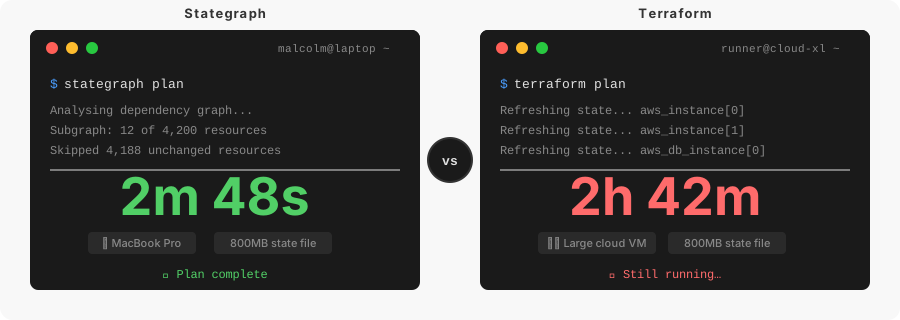
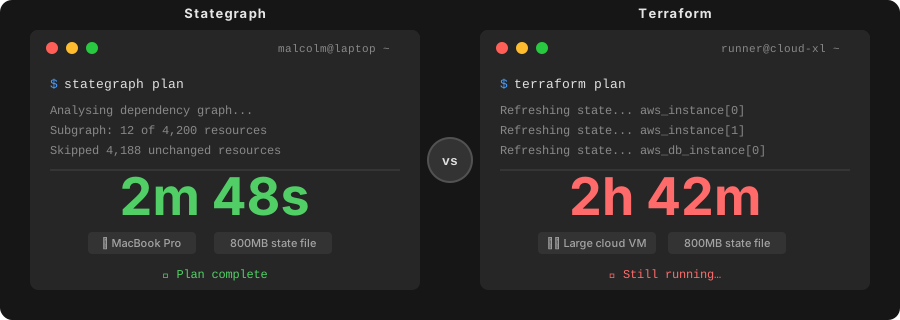
Same infrastructure. Same change. Dramatically different wait time.
Compatible with Terraform and OpenTofu
Stategraph API connects with your team's IaC solution. Terraform and OpenTofu can't handle the speed or scale AI teams operate at.
Terraform AI workflows
With Stategraph Velocity, you can execute deployments hundreds of times quicker than just standard Terraform.
OpenTofu AI workflows
As founding members of OpenTofu, we know how to leverage the open source solution to deliver fast, safe results.
What Makes Velocity Fast?
Subgraph Execution
Only process resources affected by your change. The dependency graph tells us exactly which resources need to be evaluated, so we skip the rest.
Parallel Operations
When changes don't overlap, run them simultaneously. Multiple teams can work on the same codebase without waiting in a queue.
Resource-Level Locking
Lock only what you need. No more global state locks that block everyone while one person runs a plan on a single resource.
Incremental Refresh
Refresh only changed resources, not the entire state. For large deployments, this means seconds instead of minutes.
SQL-Queryable State
Your infrastructure state lives in PostgreSQL. Query it directly, build dashboards, integrate with your existing tools.
Familiar CLI
Run plan and apply through stategraph. Same verbs, same workflow, dramatically faster execution.
Speed is downstream of the substrate
LLMs fail at raw Terraform because the primitive is wrong. Stategraph changes the primitive.
Scope the key, not the prompt
“Only plan, never apply” in a system prompt is a suggestion, not a boundary. A confused or jailbroken model ignores prose. The one thing an agent cannot argue its way past is the credential you hand it — so Stategraph scopes the credential, on two axes the agent literally cannot step outside.
// two axes the agent cannot step outside
Plan-only, or plan and apply.
Two separate grants, gated independently — a plan-only token cannot apply. The worst case from a confused model is a wrong plan you throw away. There is no path from a confused model to a destroyed database.
Down to an address pattern in one state.
The pattern matches resource addresses in that state: * for the whole state, a prefix glob like module.foo.*, or a leading ! to deny. Everything else is untouchable.
The rest of this page is speed — fast enough to keep up with an agent. This is the other half: scoped tightly enough that you can actually hand one the keys.
Transform Your Terraform State
From flat files to intelligent, queryable database. SQL interface, dependency visualization, and transaction history in one unified console.
Drive it from Claude, Gemini, or Codex → github.com/stategraph/skills