The Real Benefits of Open Source for Enterprises and Startups
Most open source solutions advertise these key things: they’re free, secure, flexible, adaptable, or a combination of the four. None of that is false, but don't take it for granted. Each benefit depends on two teams: the maintainers, who must actually patch and design well, and the adopters, who must track updates and understand the code. Open source makes these benefits possible, but it doesn't deliver them by itself.
Open source software can now run underneath nearly everything a modern engineering team touches, from the kernel under a cloud instance to the provider plugins wiring up that instance's networking.
Ask most vendors why that happened and you get the same four-item pitch: it's free, it's secure because so many people are looking at it, it protects you from vendor lock-in, and it moves faster than anything a single company could ship alone.
Every one of those claims has a kernel of truth, but none of them is unconditional. It depends on both the team maintaining and the team adopting the open-source software.
This article runs through the actual benefits of open source software, sharing what your team needs to do to get the most out of each one.
Open source vs. proprietary solutions
Proprietary software hands you a contract: a vendor sets the roadmap, ships releases on its own cadence, and, in exchange for that lack of say, gives you a support line to call when something breaks. Open source software hands you the source code itself: you can read exactly what a dependency does and patch it yourself if a fix is taking too long, and if the maintainers ever take the project somewhere you don't want to follow, you can fork it entirely and continue on your own terms.
If you are an engineer who has spent a career shipping infrastructure as code, you already know that comparison well. You probably also know that the key distinction in level of control has a compounding effect.
A community-oriented development model means a defect discovered by one user in Berlin can get fixed by a contributor in São Paulo before a vendor has even triaged the ticket. Plus, if your organization has to meet specific security requirements, you are able to audit against the codebase.
Of course, proprietary software is often the right choice. A vendor with a service-level agreement backing its uptime and a polished interface built by a dedicated design team, backed by one company accountable when something breaks, is still an attractive option in many scenarios.
Meanwhile, the advantages of open source are only fully realized by a team that understands the access that the license grants.
A quick definition: you may know the term closed-source software. This isn’t the same, but is closely related to proprietary software. Proprietary software is legally owned by someone, while Closed-source software refers to the underlying source code, which is hidden from the public.
How open source reduces software development costs
The most obvious benefit of open source is in the cost, just not always in the way you might expect. Open source software is typically free to license, which is truly valuable at startup and enterprise scale, where a proprietary platform's per-seat pricing can turn a modest initial sum into a six-figure line item as soon as you start onboarding the team.
A team building on open source components isn't starting from zero, as everything is backed by a global community's ongoing work. A payments library, a queue implementation, or a provider plugin that someone else already wrote and fixed after their own outages is available for reuse, instead of requiring you to run a multi-sprint project of your own.
There is a huge benefit to be had from using other contributors' work. Harvard Business School research estimates that if open source software disappeared entirely, the average firm would need to spend 3.5 times more on software than it currently does to rebuild the equivalent functionality in-house, a demand-side value estimated to be worth $8.8 trillion globally.
The hidden costs open source doesn't eliminate
Free refers to the license, not the operation. Someone on your team still has to integrate that provider plugin and keep it patched, and each member of your team needs to understand the internals well enough to debug it when on-call.
That possible salary impact doesn't show up on the software line item, even though it's every bit as real a cost.
Running your own Terraform state backend instead of paying for a managed one trades a subscription fee for engineering hours spent on backups and access control, plus locking behavior nobody outside the team ever sees.
The total cost of ownership for open source software includes the license cost and the cost of running it well, so it's important to factor that into your budget.
How open source improves software security and reliability
The "many eyes" argument for open source security posits that due to the number of people reading a codebase, bugs and security flaws get spotted and patched faster than they would behind a closed door that only the vendor's own engineers have access to.
Many open source projects attract contributors and security researchers from outside the organization that started it. These people have no stake in a feature being shipped on time nor any incentive to find and report what's broken.
Having a public issue tracker means that the bug fixes for a discovered vulnerability usually get shipped faster than would be possible in a proprietary vendor's private disclosure and release cycle.
However, the "many eyes" argument is heavily dependent on how effective an open source project is at attracting contributors, whether the owner can foster a collaborative approach (rather than everyone forking for their own benefit), where those contributors are looking, and if they are making continuous improvements.
Why "more eyes on the code" only works if someone's watching
Black Duck's 2026 Open Source Security and Risk Analysis report found that 78% of the commercial codebases it audited contained open source components with high-risk vulnerabilities, and 93% of those codebases were running components with no development activity in the past two years, up from 91% just a year earlier.
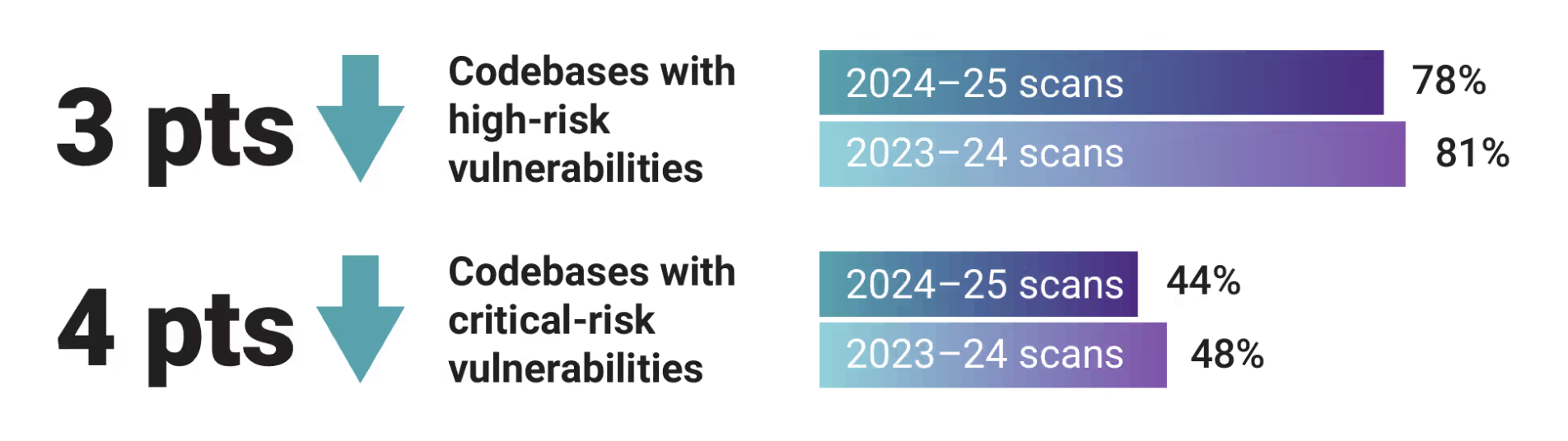
Plenty of eyes were theoretically available; they just weren't looking at the components in the dependency tree.
An abandoned open source project gets zero benefit from the many-eyes argument: the eyes left when the maintainers did.
A dependency with zero or too few maintainers is likely running code nobody is auditing or watching for the next disclosed vulnerability, which has an effect that is indistinguishable from that of a proprietary black box.
Supply-chain hygiene has become the modern complement to open source's security pitch: teams running dependency and vulnerability scanning against every module and provider they pull in, tracking a software bill of materials, and treating an unmaintained dependency as a finding rather than a fact of life.
The reality is, though, that just a license doesn't tell you if anyone's still home.
How open source helps you avoid vendor lock-in
The benefits and risks of open source software become more apparent the moment your team has to migrate off a platform.
The open-source pitch is that, because you have the source code, no single vendor controls whether your infrastructure keeps working, what it costs next year, or whether a company folds, gets acquired, or decides your use case is no longer strategic.
You can fork it, self-host it, or hire someone else to maintain it. Ultimately, you avoid vendor lock-in.
That's only half the picture, though. Your code may depend on software solutions with open licenses, but that says nothing about the portability of the execution layer running that code, the orchestration wrapping it, or the control plane coordinating it across your environments.
A team can run fully open source Terraform or OpenTofu configuration and still be locked into a proprietary runner, a closed control plane, or a workflow engine that only exports data in a format nobody else's tooling can read.
To avoid vendor lock-in, you need to consider the whole stack any change travels through, from the configuration language down to whatever executes the plan and stores the result, not just the license on the open-source layer.
What are a project's community health signals?
Look past the star count and check who controls a project before betting long-term infrastructure work on it. Foundation-backed governance, where a neutral body like the Linux Foundation holds the trademark and a technical steering committee spans multiple companies, means no single vendor can unilaterally relicense the project out from under you.
A wide, active contributor base and steady commit and issue velocity reveal that the project is alive rather than coasting on past momentum, and its relicensing history tells you what it will actually do under commercial pressure, rather than what its marketing promises.
OpenTofu is a good example. HashiCorp changed Terraform's license in 2023, and within weeks a coalition of companies and contributors had forked the project under Linux Foundation governance rather than accept the new terms.
It happened in public, and it's well documented; whatever you think of the outcome, this is exactly the kind of governance stress test to check for before you commit.
How open source speeds up product innovation
A single vendor's roadmap is dependent on which engineers it can afford to hire and which priorities its sales team feeds back from its biggest accounts.
An open source project's roadmap is dependent on how many contributors show up, which for a widely adopted project can be an order of magnitude larger, pulling from a far wider range of real-world use cases than any single company would ever staff internally.
GitHub's 2025 Octoverse report recorded 1.12 billion contributions to public and open source repositories over the year, including a single month, March 2025, in which 255,000 people made their first open source contribution ever. It is no surprise, then, that open source projects tend to grow integrations and edge-case fixes faster than proprietary alternatives, feature for feature.
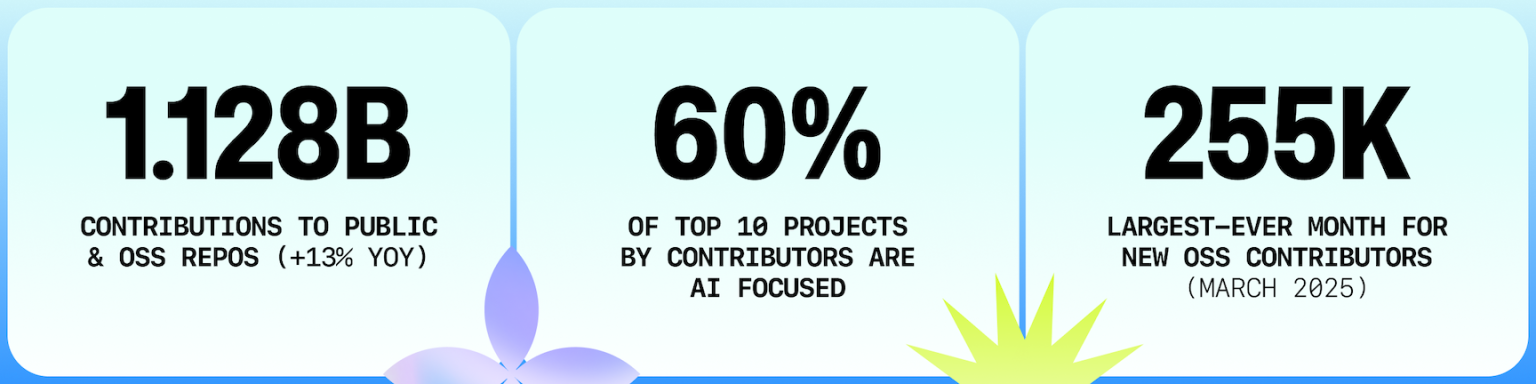
Ecosystems with a broad, active contributor base obviously have the greatest benefits, as opposed to those with a handful of maintainers.
Let's look at infrastructure tools as an example: a provider ecosystem spanning thousands of cloud services and SaaS platforms has a large community building integrations that a single vendor would never have prioritized on its own.
The fact that the collective output of an ecosystem community outpaces what a single vendor can manage is why modern infrastructure tools keep getting built on top of open foundations – instead of replacing them.
Why enterprises adopt open source solutions
Organizations increasingly turn to open source solutions for reasons that have little to do with the cost savings an individual engineer cares about. There are a number of reasons to take into account, however.
Regulatory compliance
A codebase you can read end to end is one you can test and demonstrate compliance controls against, rather than taking a vendor's word for what its proprietary software affords.
Auditors expect that level of transparency, particularly in regulated industries where a vendor's verbal assurance will never satisfy a security questionnaire.
Avoiding single-vendor dependency
The blast radius of a bad vendor decision is larger at enterprise level. A licensing change or an acquisition that shifts a vendor's priorities affects every team and application built on that platform at once, across an organization that might run hundreds of internal projects on it.
Attracting talent
Many engineers already know OpenTofu, Kubernetes, Postgres, and other commonly used open-source solutions, as they are widely taught, which makes hiring and onboarding faster than it would be for a proprietary equivalent with a smaller, harder-to-find talent pool.
Regardless, whether or not you adopt an open source is not a decision an organization can just make once and forget.
Enterprise-scale open source, for example, still needs internal governance: someone has to:
- Own the security review process for every new dependency
- Track licensing obligations across hundreds of components
- Maintain in-house expertise so they can operate the software without leaning on open source community forums when something breaks
- Monitor the health of each project so an unmaintained dependency gets replaced before it becomes a liability
Stategraph and open source
Stategraph is two pieces that plug into each other, a division that works in your favor. Stategraph Orchestration is open source under MPL-2.0: it's the engine that runs your actual Terraform and OpenTofu plans from pull requests, with policy checks, cost estimates, and drift detection built in.
You can self-host it today, inspect it, and run it as free software for a small team, with an Enterprise Edition ready when you outgrow that.
Stategraph's infrastructure-as-a-database offering is the commercial layer on top: it takes your state and turns it into a queryable graph in PostgreSQL, replacing the single global lock of a flat state file with per-resource conflict detection and plans that scale with your changes instead of your whole infrastructure.
You can run it hosted, self-host it in your own VPC, or have Stategraph operate it inside your own cloud account with BYOC. Your state and your credentials never have to leave your infrastructure.
Adopting either is low-risk. You can fork the open-source orchestration engine outright, while the database layer is reversible by design: stategraph states export writes a standard terraform.tfstate back out at any point, so trying it costs you nothing you can't undo.
Because the open-source orchestration engine is the part of Stategraph actually driving Terraform and OpenTofu, we are investing directly in that ecosystem, not just riding on it.
Conclusion
The benefits of open source include:
- Lower upfront costs
- Security that improves faster than a closed alternative
- Freedom from being tied to one vendor's decisions
- An innovation velocity that a single company's roadmap can't match on its own
However, that is all dependent on who is maintaining and using it. Cost savings hinge on the operational investment behind them, security relies on active maintenance rather than the license alone, and lock-in avoidance rests on the entire stack staying open, not just the open source code you can see.
You should hold any tool you adopt to the standard, especially those that will manage an open ecosystem.
Stategraph is built on that premise when it comes to infrastructure as code (IaC): keep your Terraform and OpenTofu exactly as they are, get a queryable, portable layer underneath them, and judge it by its openness and reversibility.
Try Stategraph free to see whether it suits your needs.
The benefits of open source FAQs
What are the real business benefits of open source?
The core business benefits of open source software are cost efficiency from avoiding licensing fees and reusing existing systems and components, community support that supplements or replaces a vendor's help desk, security that improves when a project is actively maintained rather than automatically, and faster innovation from a contributor base that is larger than any single vendor could staff. Each benefit still requires the operational work covered above to actually materialize.
What are the advantages of open source for startups?
Startups face a different decision than larger Enterprises when it comes to the key benefits of open source. Lower upfront costs mean a small team can start building without a licensing budget, and open source components let founders assemble a working product faster than writing everything from scratch.
By contributing back to open source projects, startup teams can build credibility with technical buyers and make their startup a more attractive option to the engineers they are trying to hire, as the candidates can already see the team's real work in public.
Does using open source improve developer productivity and retention?
Yes, but there are conditions. Engineers who can read and contribute to the real code behind tools tend to learn faster than those working entirely inside a closed system, and a public contribution history doubles as a portfolio that follows them between jobs.
Harvard Business School researchers studying the value of open source software found that firms are willing to pay employees to spend part of their time maintaining the open source projects they rely on, treating that work as a retention tool rather than a distraction from it.
What are the risks of open source software?
Key risks include the fact that some projects get thoroughly reviewed while others sit quietly abandoned, and unmaintained dependencies turn into a real attack surface for business operations, especially when you depend on rapid development. Running any of it well at scale takes in-house expertise that most teams underinvest in.